
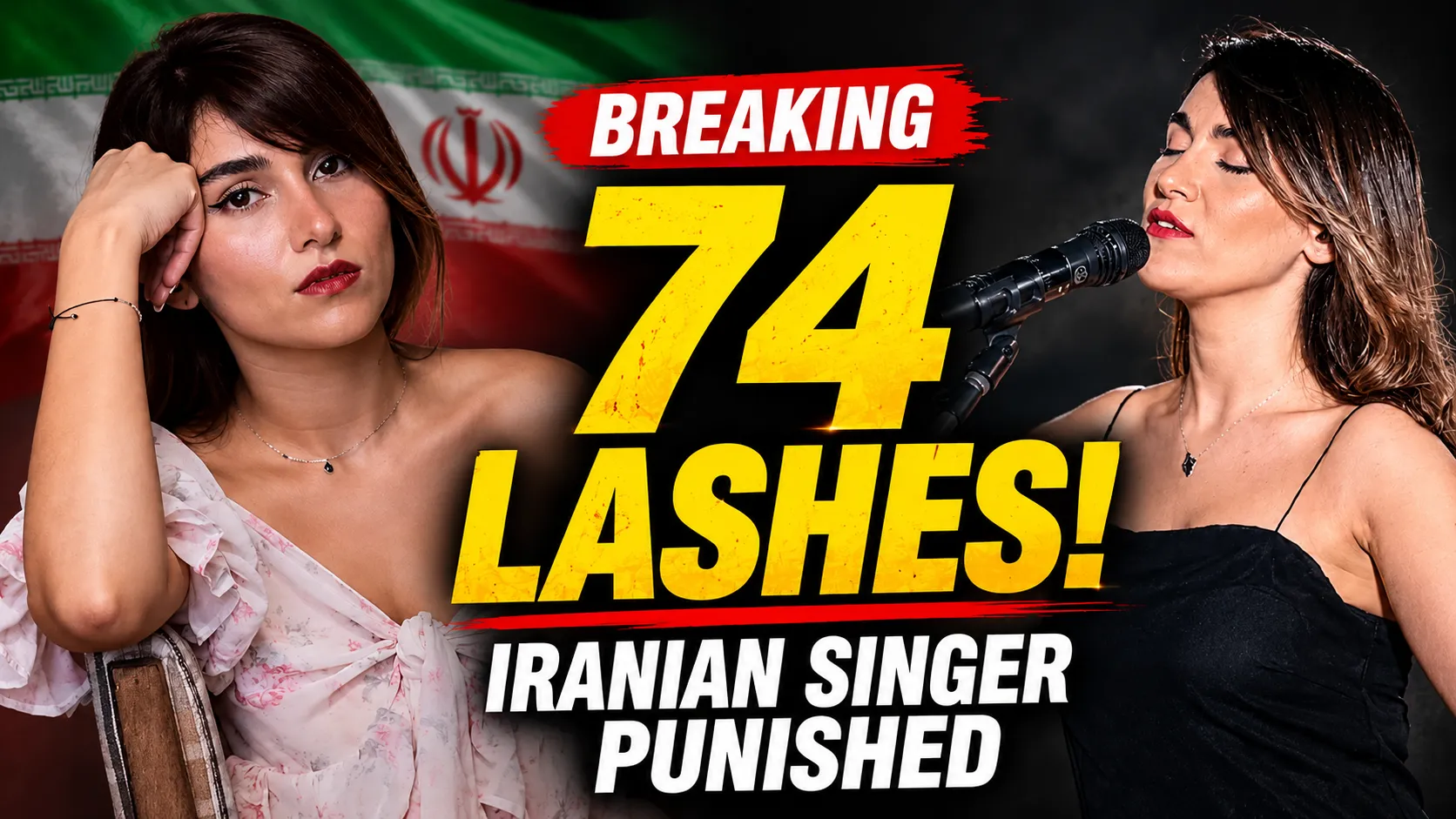
An online concert that once became a symbol of artistic freedom in Iran has now led to a shocking punishment for singer Parastoo Ahmadi. Iranian authorities have carried out a sentence of 74 lashes against the singer and four members of her concert team over a performance in which she appeared without a hijab.
The punishment was carried out in Qom after a legal battle that began with a YouTube concert in December 2024. Ahmadi had performed alongside male musicians at a historic caravanserai, wearing a sleeveless black dress with her hair uncovered. There was no live audience, no traditional concert hall and no large public gathering. The performance was streamed online, where it quickly attracted millions of viewers.
Now, nearly two years later, the same performance has brought serious consequences for everyone involved. Apart from the physical punishment, the group also faces restrictions on artistic activities and travel outside Iran.
The news has sparked fresh criticism from human rights organisations and renewed attention to the restrictions faced by women musicians in the country.
In an act of extraordinary courage, Iranian female singer Parastoo Ahmadi live-streamed herself singing without the mandatory hejab in a Tehran caravanserai, risking years of imprisonment. Another crack in the foundations of Iran’s rotting theocracy. https://t.co/uHuiVCgVKV
— Karim Sadjadpour (@ksadjadpour) December 12, 2024
Parastoo Ahmadi and Four Others Receive 74 Lashes in Iran
The punishment against Parastoo Ahmadi was carried out on Monday at the sentence enforcement office of the Qom prosecutor’s office.
According to lawyer Mostafa Nili, who spoke about the case through the Iranian news outlet Emtedad, Ahmadi and four members of her concert team each received 74 lashes.
The four men identified in the case are:
- Soheil Faghih-Nasiri
- Amin Taheri
- Amirali Pirnia
- Mohsen Lashkari
Pirnia and Faghih-Nasiri were among the musicians who performed alongside Ahmadi, while Lashkari was involved in organising the concert.
The punishment followed a court decision against the group over the production and online publication of material described by Iranian authorities as obscene and immoral.
The sentence was not limited to flogging. Those affected were also handed a two-year ban on artistic and musical activities and a two-year restriction on leaving the country.
The case involved nine defendants in total, although the latest reported enforcement concerned Ahmadi and these four members of her team.
What Happened at Parastoo Ahmadi’s Concert Without Hijab?
The story goes back to December 11, 2024, when Parastoo Ahmadi released a performance filmed at the historic Deir Gachin Caravanserai near Qom.
She appeared on a small stage wearing a long black sleeveless dress, with her hair falling freely over her shoulders. Four male musicians performed alongside her.
What made the performance unusual was the setting. Iran has strict rules governing women’s public appearances and musical performances, including compulsory hijab requirements. Female singers also face restrictions on performing publicly in front of mixed-gender audiences.
Ahmadi decided to perform anyway.
The concert was presented as an online performance without a physical audience. She described it as a hypothetical concert, a way of singing for people despite the restrictions that made a conventional performance difficult.
The video quickly spread across social media and YouTube. It attracted around three million views within days, turning the performance into a widely discussed moment in Iran’s ongoing debate over women’s rights and artistic freedom.
For many viewers, it was more than a musical performance. It was a woman choosing to sing publicly without following a dress requirement that has become increasingly controversial in the country.
Why Did Iranian Authorities Take Action Against Parastoo Ahmadi?
Iranian authorities took issue with several aspects of the performance.
Ahmadi had appeared without the mandatory headscarf, worn a sleeveless outfit and performed alongside male musicians. The video was also published online, allowing viewers inside and outside Iran to watch it.
Iranian laws impose strict dress requirements on women and restrictions on public musical performances by female singers. These rules have been a major source of conflict, particularly since the nationwide protests that followed Mahsa Amini’s death in 2022.
Following the release of the concert video, authorities opened a case against Ahmadi and members of her team. The legal complaint focused on the production and distribution of content that prosecutors considered contrary to public decency.
The charges were not simply presented as a disagreement over clothing. The court described the published performance as obscene and immoral content.
The defendants disputed the allegations, but the legal proceedings continued.
What Was the Court Verdict Against Parastoo Ahmadi?
The case moved through the Iranian judicial system after the performance became public.
In June 2026, a criminal court in Qom convicted Ahmadi and eight other people involved in the case. The sentence included 74 lashes, restrictions on artistic and audiovisual activities, and a two-year ban on leaving Iran.
The defendants challenged the decision, hoping to have the punishment overturned, reduced or suspended.
However, the Qom appeals court upheld the verdict at the end of September 2026.
Their legal team continued trying to prevent the punishment from being carried out. But those efforts were unsuccessful, and the enforcement office proceeded with the lashes against Ahmadi and four members of her team.
The fact that the case moved from an online performance to a physical punishment has made it particularly controversial.
Who Is Parastoo Ahmadi?
Parastoo Ahmadi is an Iranian singer known for her performances of Persian music and songs connected to social and cultural themes.
She was born in April 1997 in Nowshahr, in Iran’s Mazandaran Province. She studied directing at Soore University and developed an interest in music and performance from an early age.
Unlike many mainstream singers who build their careers through television appearances and commercial concerts, Ahmadi has become known partly through online performances and music shared directly with audiences.
Her work has also attracted attention because of its connection to the social and political atmosphere in Iran.
She previously faced pressure from security authorities during the Woman, Life, Freedom movement. Her performances of protest-related songs and Mazandarani folk music brought her work to the attention of authorities.
The December 2024 caravanserai performance became the most widely discussed moment of her career, but it was not the first time her music had been connected to wider public debates.
Parastoo Ahmadi’s Connection to the Woman, Life, Freedom Movement
To understand why Ahmadi’s performances have received so much attention, it is worth looking back at the protests that began in Iran in September 2022.
The movement known as Woman, Life, Freedom emerged following the death of Mahsa Amini, a 22-year-old Kurdish Iranian woman who died in custody after being detained by morality police over alleged dress-code violations.
The incident triggered demonstrations across Iran and drew international attention to compulsory hijab laws, women’s freedom and government restrictions.
During this period, Ahmadi performed the protest song “Az Khoone Javanane Vatan”, often translated as “From the Blood of the Youths of the Homeland”.
The song circulated widely and connected with people who were expressing anger over the treatment of protesters and the restrictions imposed on women.
Following the attention surrounding her performances, security forces reportedly searched her home and ordered her to report to the security prosecutor’s office in Tehran.
Her December 2024 performance was therefore not an isolated incident. It came after several years in which her music had become associated with discussions about freedom, identity and women’s rights in Iran.
What Did Parastoo Ahmadi Say About Her Concert?
Before the legal case became the major international story it is today, Ahmadi shared a message explaining why she wanted to perform.
She described the performance as a hypothetical concert and expressed her desire to sing for the people she loved and for the country she cared about.
Her message reflected something that had been missing from her professional life: the ability to perform freely in front of an audience.
The online concert allowed her to reach people without organising a conventional public event. The musicians, the historic setting and her appearance without a headscarf all became part of what made the video so widely discussed.
Rather than treating the performance as an ordinary music video, many viewers saw it as a statement about the ability of Iranian women to make their own choices.
Why Has the Parastoo Ahmadi Case Sparked International Outrage?
The news has attracted criticism because of the severity of the punishment and the circumstances surrounding the performance.
Human rights organisations have repeatedly criticised flogging as a form of cruel, inhuman and degrading punishment. Amnesty International has also called for sentences against Ahmadi and the other defendants to be overturned.
The organisation has argued that corporal punishment violates international human rights standards and that people should not face criminal penalties for expressing themselves through music and artistic performances.
The case has also drawn attention to the wider situation facing Iranian women who challenge compulsory dress requirements.
Since the 2022 protests, more women have appeared in public without headscarves despite the possibility of legal consequences. Enforcement has varied, but cases involving female artists continue to attract significant attention.
For international observers, the Ahmadi case highlights the gap between the increasing visibility of women challenging restrictions and the government’s continued use of the judicial system to enforce them.
What Happens Next for Parastoo Ahmadi?
The latest reported development is the enforcement of the 74-lash sentence against Ahmadi and four members of her concert team.
The two-year restrictions on artistic and musical activities and international travel are also part of the punishment.
There has been no independently confirmed announcement of a further legal outcome that reverses the sentence. The enforcement has instead intensified calls from rights groups and supporters for an end to corporal punishment and restrictions on women’s artistic expression.
The case is likely to remain a significant subject of discussion around freedom of expression in Iran, particularly as musicians and other artists continue to challenge restrictions through online platforms.
Parastoo Ahmadi’s Story Goes Beyond One Concert
What began as a performance filmed at a historic location near Qom has become an international human rights story.
Parastoo Ahmadi wanted to sing without the restrictions that have shaped the careers of many female performers in Iran. The video reached millions of people, but it also brought legal consequences that extended far beyond the original performance.
The punishment against Ahmadi and four members of her team has brought renewed attention to the country’s compulsory hijab rules and the difficulties faced by women who want to perform publicly.
For many people who watched the original concert, the striking part was how simple the performance appeared: a singer, a few musicians and a song. Its consequences, however, have shown just how complicated the freedom to perform can be in Iran.