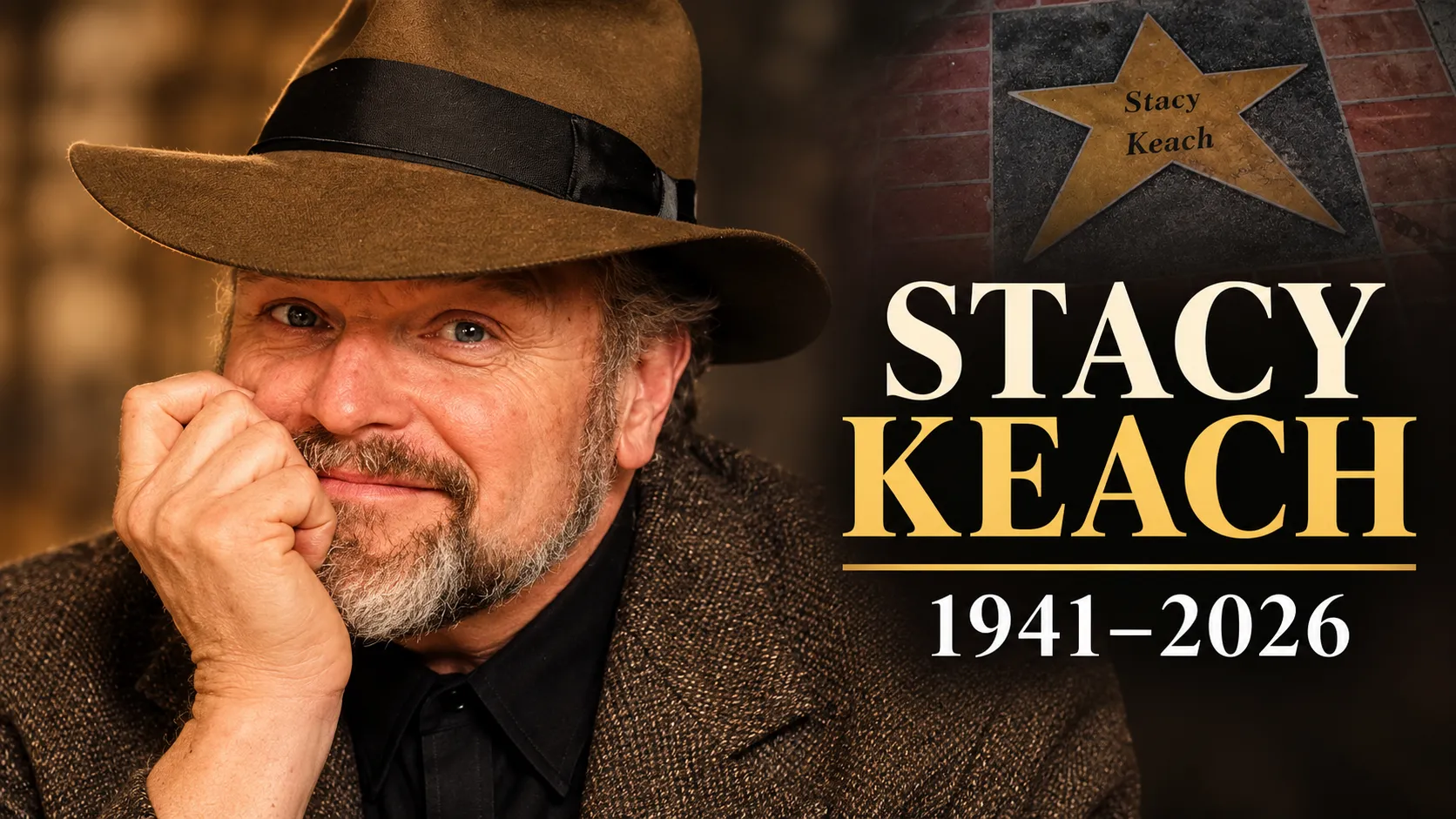
Hollywood has lost a familiar face and one of its most distinctive voices. Stacy Keach, the veteran actor best remembered for playing tough private detective Mike Hammer, has died at the age of 85. His death was announced on November 10, 2026, by his wife, Małgosia Tomassi Keach, who confirmed that he passed away at their family home in Poland following a prolonged battle with a serious heart condition and heart failure.
For many viewers, Keach will always be the man behind Mike Hammer, the hard-boiled detective who became a television favourite during the 1980s. Others will remember him as Warden Henry Pope from Prison Break, Cardinal Kevin Kearns from Blue Bloods, or the commanding presence he brought to countless film and television appearances. His career lasted more than six decades, and what made him unusual was his ability to move between very different kinds of acting without losing his identity on screen.
But Keach’s story was about much more than successful television roles. He experienced major career setbacks, personal struggles and difficult chapters that could easily have ended his journey in Hollywood. Instead, he found his way back and continued working well into his eighties.
The Actor Behind Mike Hammer
Born Walter Stacy Keach Jr. on June 2, 1941, in Savannah, Georgia, Keach grew up in a family closely connected to the performing arts. His father was an actor and drama teacher, while his mother had an interest in acting. His younger brother, James Keach, also went on to build a career in the entertainment industry.
Acting was clearly more than a passing interest for him. Keach studied at the University of California, Berkeley, before continuing his education at the Yale School of Drama. He also studied at the London Academy of Music and Dramatic Art as a Fulbright Scholar. That classical training would become an important part of his identity, particularly when he began taking on demanding Shakespearean roles.
Although he appeared in films and theatre productions throughout the early part of his career, his portrayal of Mike Hammer brought him widespread recognition. Based on the fictional detective created by writer Mickey Spillane, the character was tough, impatient and rarely impressed by anyone standing in his way. Keach played him with exactly the kind of rough confidence that made the detective believable.
He returned to the role in multiple television productions, including Mickey Spillane’s Mike Hammer and The New Mike Hammer. For an entire generation of television viewers, his face and voice became inseparable from the character.
His Career Was Far Bigger Than One Famous Detective
It would be easy to remember Keach only for Mike Hammer, but doing so would overlook some of the strongest performances of his career. In 1972, he starred in John Huston’s boxing drama Fat City, playing Tully, a struggling fighter trying to find another chance at life. The film remains one of his most respected performances and helped establish him as a serious dramatic actor.
His theatre work was equally impressive. Keach appeared in numerous Shakespeare productions, including Hamlet, Macbeth, Richard III and King Lear. He also earned a Tony Award nomination for his Broadway performance as Buffalo Bill Cody in Indians. His stage achievements eventually led to his induction into the American Theater Hall of Fame in 2015.
On screen, his filmography included The Long Riders, Up in Smoke, American History X, Nebraska and The Bourne Legacy. He also appeared in television projects such as Titus, The Blacklist, Ray Donovan and Blue Bloods. His voice became familiar to younger audiences through animated projects, including Pixar’s Planes: Fire & Rescue, where he voiced Skipper.
One of his later appearances was in Noah Baumbach’s 2025 Netflix film Jay Kelly, featuring George Clooney and Adam Sandler. It was another reminder that Keach remained part of the acting world even as many performers of his generation had stepped away from regular work.
The Difficult Chapter That Nearly Destroyed His Career
Keach’s life was not without controversy. In 1984, he was arrested at London’s Heathrow Airport in connection with cocaine smuggling. He pleaded guilty and served six months in prison in Britain, a period that became one of the most difficult experiences of his life.
At the time, his career was moving forward, and the arrest threatened to undo years of professional success. His imprisonment also brought unwanted attention to his personal struggles with cocaine addiction. Rather than pretending the experience had never happened, Keach later spoke openly about his addiction and the consequences of his decisions.
He eventually returned to acting, with his comeback beginning through television work in the mid-1980s. His return as Mike Hammer was particularly significant because the character had already helped establish him as a household name. He also became involved in efforts to educate people about substance abuse and addiction, using his own experiences to encourage others to seek help.
It was a difficult chapter, but it never became the final chapter of his career.
Prison Break Introduced Him to a New Generation
Even though Keach had been famous for decades, younger television audiences discovered him through Prison Break. He played Warden Henry Pope, the prison official responsible for Fox River State Penitentiary, where Michael Scofield and the other inmates were held.
Pope was not written as a simple villain. Keach gave the character a mixture of authority, personal decency and occasional vulnerability, making him more interesting than a typical prison administrator. His scenes with Wentworth Miller became an important part of the show’s early seasons.
The role introduced Keach to viewers who might never have watched Mike Hammer or seen his Shakespeare performances. It also demonstrated how comfortably he could fit into a completely different generation of television storytelling.
Later appearances in The Blacklist and Blue Bloods continued that connection with audiences who recognised him from his distinctive voice and screen presence.
His Wife and Family Were at the Centre of His Later Life
Keach was married to Małgosia Tomassi, whom he met while working on the Mike Hammer television series. The couple married in 1986 and built a life together that eventually included two children, Shannon and Karolina.
They spent considerable time in Poland, where Keach was living at the time of his death. His wife described him as a courageous man who faced his illness with remarkable determination. Her statement also reflected the personal loss experienced by a family that had shared nearly four decades together.
Keach was also an advocate for people affected by cleft lip and palate conditions. He had been born with a cleft lip and a partial cleft of the hard palate and underwent several operations as a child. He later supported the Cleft Palate Foundation, helping raise awareness about a condition that had shaped his own early life.
Stacy Keach Leaves Behind a Career That Refused to Fit Into One Category
Some actors become famous because of one character. Others are remembered for a particular film or a defining performance. Keach managed to leave his mark across several different worlds of entertainment. He could play a Shakespearean king on stage, a struggling boxer in a serious drama, a television detective, a prison warden or a powerful family figure.
His career also carried a lesson about resilience. The arrest and prison sentence in 1984 could have ended his professional journey, but he returned to the industry and continued building an impressive body of work. He never completely disappeared from screens, and even in his later years, filmmakers continued finding roles suited to his talent.
Stacy Keach is survived by his wife, Małgosia, and their two children, Shannon and Karolina. His death marks the end of a remarkable acting career, but his performances will remain available to audiences who want to revisit the characters he brought to life.
For longtime fans, he will always be Mike Hammer. For a younger generation, he may be the unforgettable warden from Prison Break. And for those who followed his entire career, he was something much harder to define: a remarkably versatile actor who never stopped working.