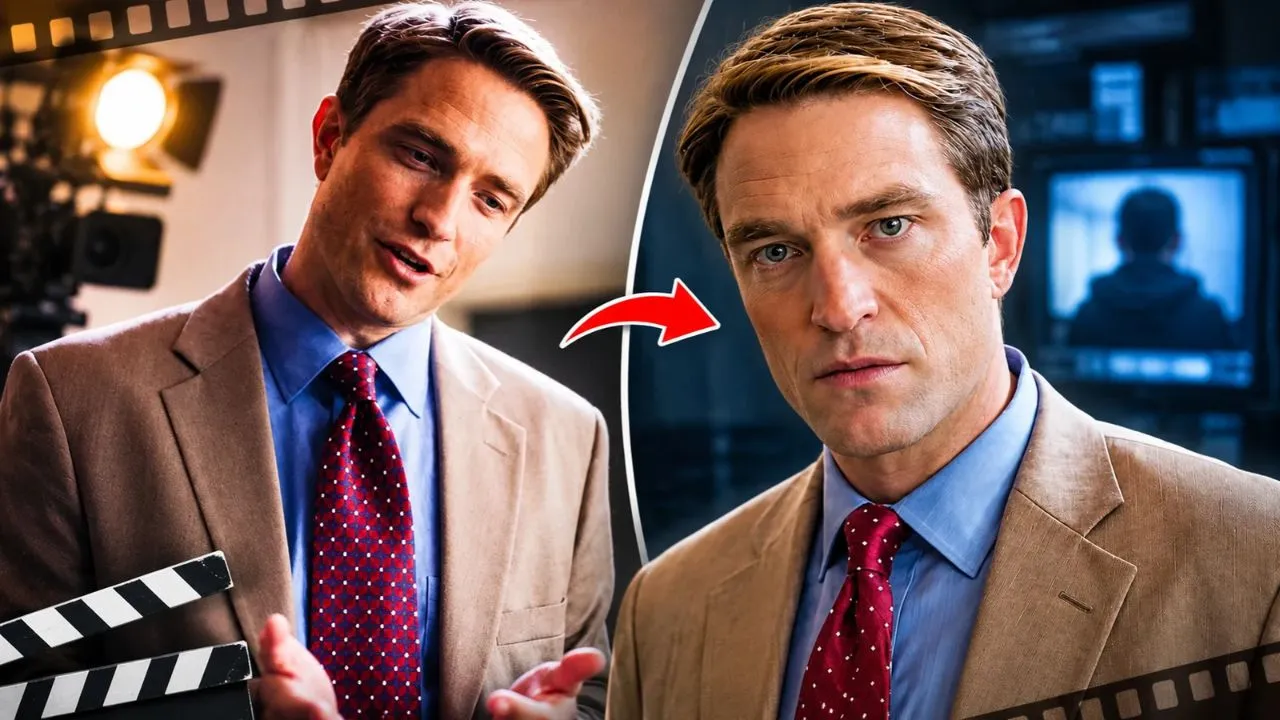
Robert Pattinson wasn’t originally planning to play Chris Hansen. When he first became involved with Primetime, his role was behind the camera. He was helping develop the film as a producer, working with director Lance Oppenheim and screenwriter Ajon Singh on a story inspired by the controversial television series To Catch a Predator.
Somewhere during that process, however, Pattinson became increasingly drawn to the character. What began as a project he was helping shape eventually turned into one of the most unusual acting challenges of his career.
The change didn’t happen through a traditional casting process. According to Oppenheim, one late-night meeting at Pattinson’s house helped move things forward. The director and writer had stayed until around 2 a.m., bringing Four Loko drinks and gummies along with them. They were discussing the script and trying to communicate the strange, heightened atmosphere they wanted the movie to have.
Oppenheim later recalled the meeting in an interview with Entertainment Weekly. He had always believed Pattinson was right for the part, but the actor initially seemed unsure about what they were trying to create. After the conversation, Oppenheim and Singh spent several weeks working on another version of the script.
A few days passed without Pattinson giving them an answer. Oppenheim even thought the opportunity might have fallen through. Then Pattinson called him and said he was going to make The Drama with Zendaya and would also do Primetime.
That decision changed the entire shape of the project. Pattinson was no longer simply helping produce a film about Chris Hansen. He was going to become the face of it.
The hardest part wasn’t looking like Chris Hansen. It was sounding like him.
Anyone familiar with To Catch a Predator knows that Hansen’s delivery was a huge part of the show’s identity. His calm, controlled voice, carefully timed questions and slightly theatrical way of confronting people became instantly recognisable. It was also the reason his appearances were repeatedly turned into internet memes.
Pattinson quickly discovered that recreating that voice was much harder than simply watching a few clips and copying the way Hansen spoke.
He spent many hours studying old footage of the television host and listening to his podcast. Videos, online discussions and Reddit threads were also being sent to him by Oppenheim and Singh as they developed the character. Pattinson described the preparation as an enormous amount of work, calling the role particularly difficult because of the voice.
He had to understand more than Hansen’s accent. The character’s rhythm, expressions and relationship with the camera were all important. Hansen was a journalist who had become a television personality, and the film explores what happens when someone accustomed to reporting on events becomes the central performer in them.
Pattinson’s version was never intended to be a straightforward imitation. The filmmakers wanted to create a heightened dramatic portrait rather than a conventional biographical recreation. That distinction is important because Primetime is inspired by real events, but its scenes and characterisation are part of a scripted film.
Chris Hansen himself was not involved in making the movie. He publicly criticised the project, describing it as a work of fiction attached to his real name. Director Lance Oppenheim also explained that he wanted to explore the mythology surrounding Hansen and the television show, rather than make a traditional biopic with Hansen’s participation.
A chaotic shoot, freezing weather and one sacrificed camera
The unusual atmosphere of Primetime wasn’t limited to the script. Its production involved a series of challenging locations and complicated night shoots.
Although the story moves through places associated with different parts of the United States, much of the movie was filmed in New Orleans. The production team had to find locations that could convincingly represent California, New York, Connecticut, Florida and Texas. Oppenheim particularly liked the house used to recreate the Murphy, Texas, sting operation. Its front door, with glass slats, gave him an idea for a shot showing Chris Hansen on the other side.
The night sequences were another challenge. Skyler Gisondo, who plays a decoy in the film, described the experience as exhausting. The cast and crew spent long stretches working overnight, and he joked that everyone eventually became slap-happy and felt a little insane.
One of the most complicated scenes involved the team discovering the identity of a high-profile target referred to as the whale. Oppenheim explained to Vulture that the sequence required rain towers outside, lightning effects and live computer content playing on screens. All of these elements had to work together while the actors performed what was meant to feel like an intimate discovery.
The production also recreated Chris Hansen’s introduction from an episode set on the Jersey Shore. That sequence was filmed in the Far Rockaways during winter, shortly after a blizzard. The weather was so cold that the crew could manage only a few takes before continuing outside became too uncomfortable. Oppenheim later identified the footage as a deleted scene and said he hoped it could be released.
There was also a small production detail that sounds like something from a film set joke. During one scene, a camera ends up in a swimming pool. Oppenheim clarified that the crew didn’t destroy an expensive working camera for the shot. They used one that was already broken.
Another memorable production photograph shows Pattinson near a Lenco BearCat vehicle before the film’s raid sequence. Oppenheim wanted the moment to feel almost like an action movie, with Hansen making a dramatic entrance. After one or two takes, Pattinson reportedly asked the editor whether he looked like Mark Wahlberg in Shooter.
These details offer a better sense of what the production was trying to achieve. The film wasn’t simply recreating a television programme or copying old footage. Its director was building a deliberately heightened world, using unusual visuals, real-world locations and theatrical performances to explore the machinery of reality television.
That approach is also why the behind-the-scenes stories are so interesting. Pattinson’s casting came out of a late-night creative conversation, his performance required extensive voice work, and some of the film’s most complicated moments depended on weather effects, computer screens and carefully coordinated night shoots.
Primetime was released by A24 in US theatres on September 25, 2026. Directed by Lance Oppenheim and written by Ajon Singh, it also stars Skyler Gisondo, Merritt Wever and Phoebe Bridgers.
For Pattinson, it was more than another acting role. It was a project he helped develop from its earliest stages, only to find himself taking on the central character. And for a film about the blurred line between journalism and entertainment, that journey from producer to performer feels particularly fitting.